
1982 Penny Value, Varieties & Identification Guide
A 1982 cent can be copper or copper-plated zinc, Large Date or Small Date, Philadelphia or Denver. Start with the mint mark, then weigh the coin before you judge its value.
The regular 1982-D Small Date is zinc and weighs about 2.50 grams. The rare copper-alloy example is a different situation and needs authentication.
Specifications and variety distinctions reviewed September 18, 2026
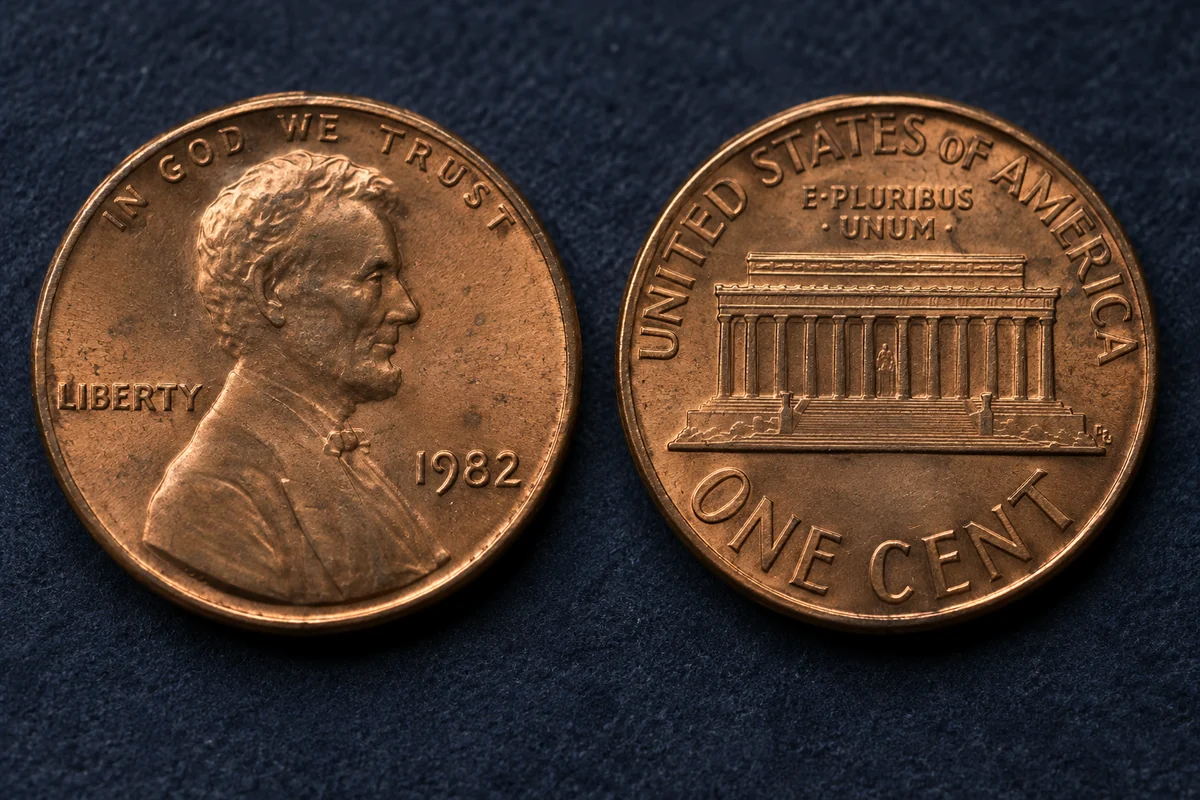
How Much Is a 1982 Penny Worth?
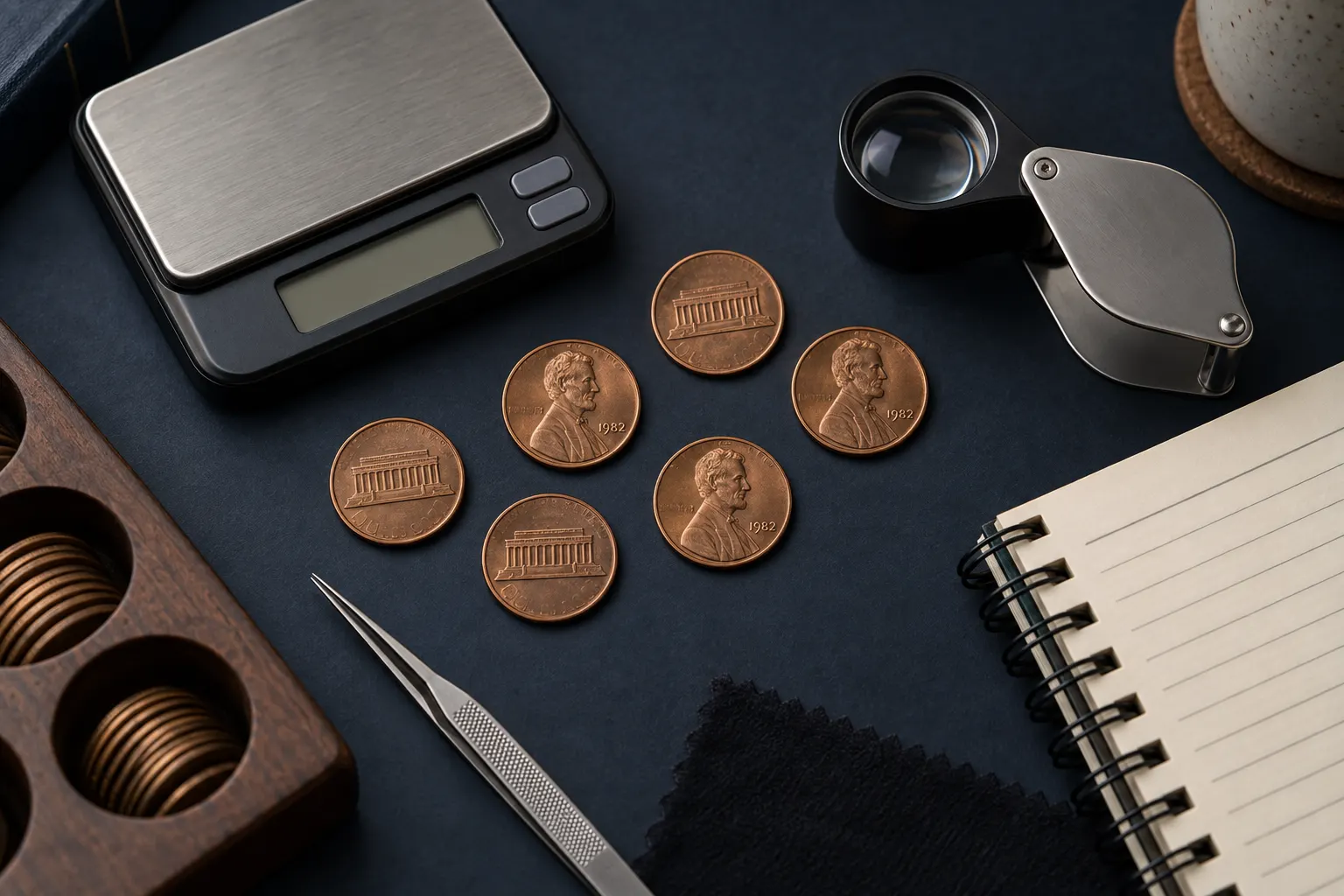
Identify the exact combination before comparing a price.
Most 1982 pennies are not rare. Value depends on the mint mark, copper or zinc composition, Large Date or Small Date design, grade, color, surface and any recognized variety or mint error. A date alone cannot identify a premium coin.
PCGS separates the 1982 cents into composition and date-size combinations. NGC describes seven regular circulating combinations and treats the 1982-D Small Date bronze discovery as a mint error rather than a normal eighth issue. That distinction prevents the most common mistake: treating every Small Date Denver cent as rare.
Eight combinations to separate
Seven regular circulating combinations plus one rare error category.
| 1982 Penny Type | Weight | Mint mark | Status | Value context |
|---|---|---|---|---|
| 1982 Copper Large Date | ~3.11 g | None | Regular issue | Usually common; grade matters |
| 1982 Copper Small Date | ~3.11 g | None | Regular issue | Premium mainly in high grade |
| 1982 Zinc Large Date | ~2.50 g | None | Regular issue | Usually common |
| 1982 Zinc Small Date | ~2.50 g | None | Regular issue | Usually common |
| 1982-D Copper Large Date | ~3.11 g | D | Regular issue | Usually common; grade matters |
| 1982-D Zinc Large Date | ~2.50 g | D | Regular issue | Usually common |
| 1982-D Zinc Small Date | ~2.50 g | D | Regular issue | Do not confuse with the error |
| 1982-D Copper Small Date | ~3.1 g | D | Rare transitional error | Authenticate before assigning value |
“Regular issue” does not mean every example has the same value. Grade, color and original surfaces can create large differences among certified coins.
How to Identify Your 1982 Penny
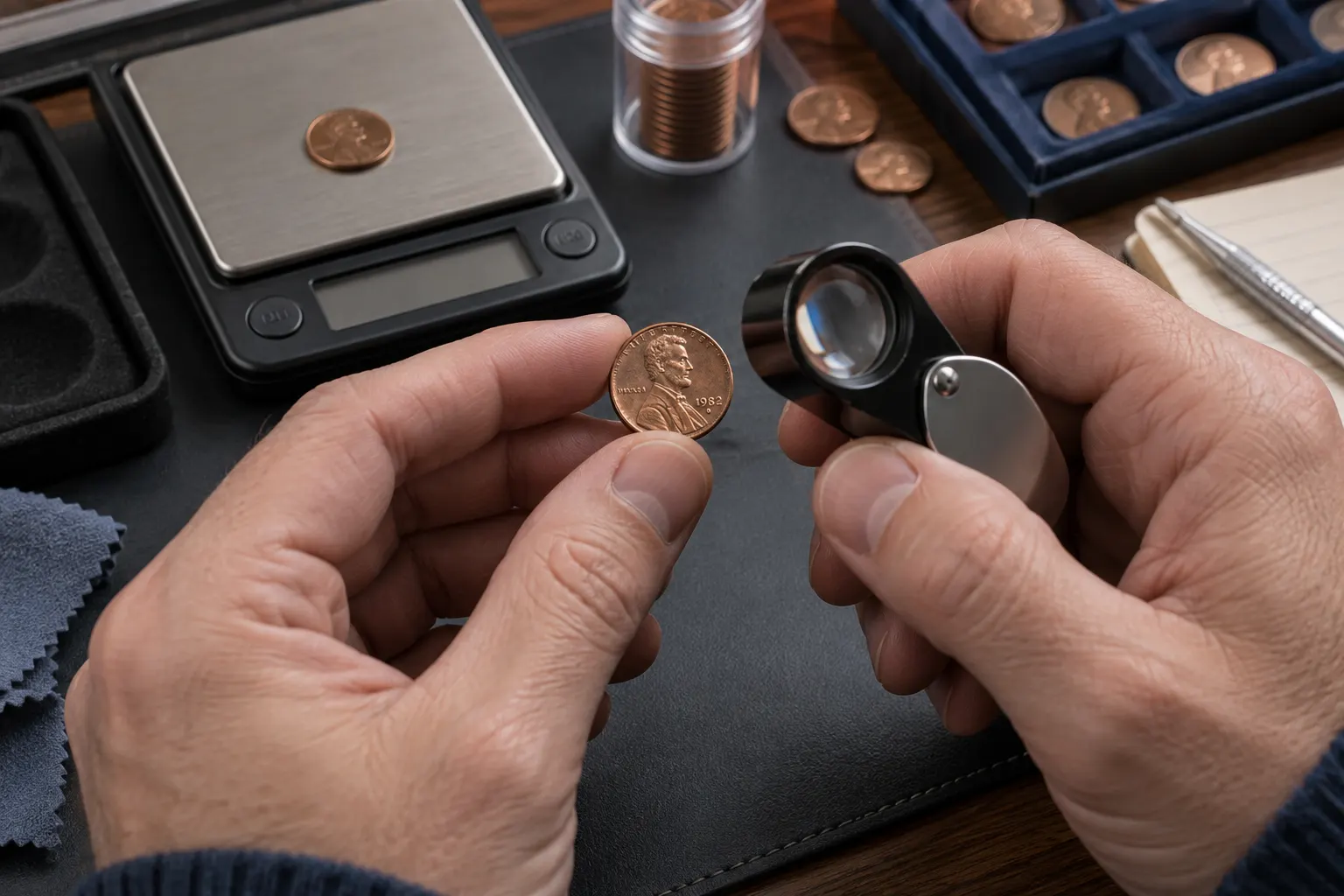
Use a non-destructive five-step screen.
A scale is more useful than a color test. Copper-plated zinc still has a copper-colored outer surface, while a circulated copper-alloy cent may be dark brown. Do not scratch, cut, heat or otherwise damage the coin to test its composition.
Is My 1982 Penny Copper or Zinc?
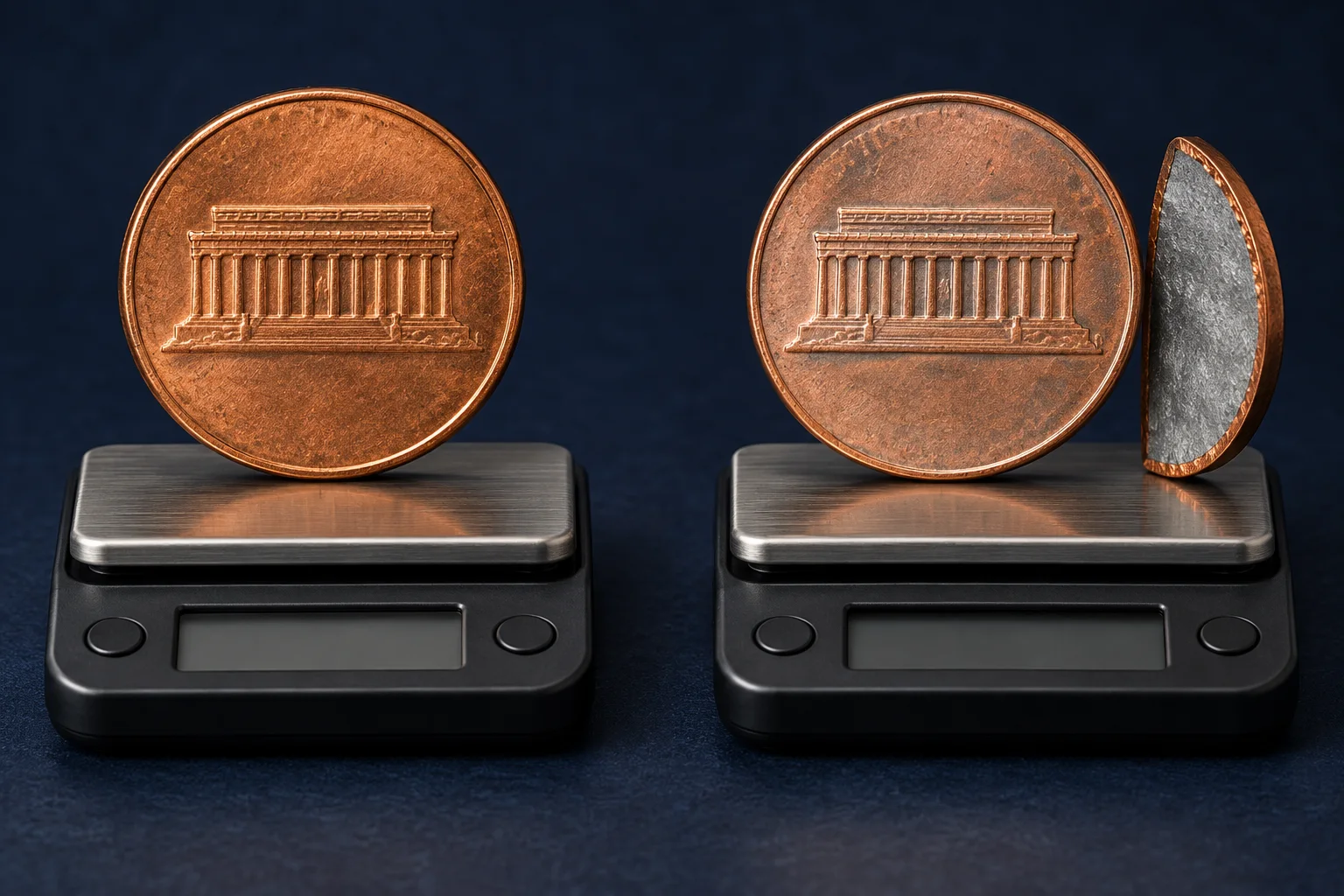
Weigh it. PCGS lists about 3.11 grams for the bronze or copper-alloy cents and about 2.50 grams for the copper-plated zinc cents. The difference is large enough for a good digital scale to screen most examples.
Weight is evidence, not authentication. Dirt, damage, a weak scale or an altered coin can mislead a quick test. If the coin also has a D mint mark and Small Date, repeat the measurement carefully before seeking professional review.
Copper-alloy class
Traditional 1982 planchets. They can be normal Philadelphia or Denver combinations depending on mint mark and date style.
Zinc class
Copper-plated zinc planchets. The regular 1982-D Small Date belongs here, not in the rare error category.
1982 Penny Large Date vs Small Date
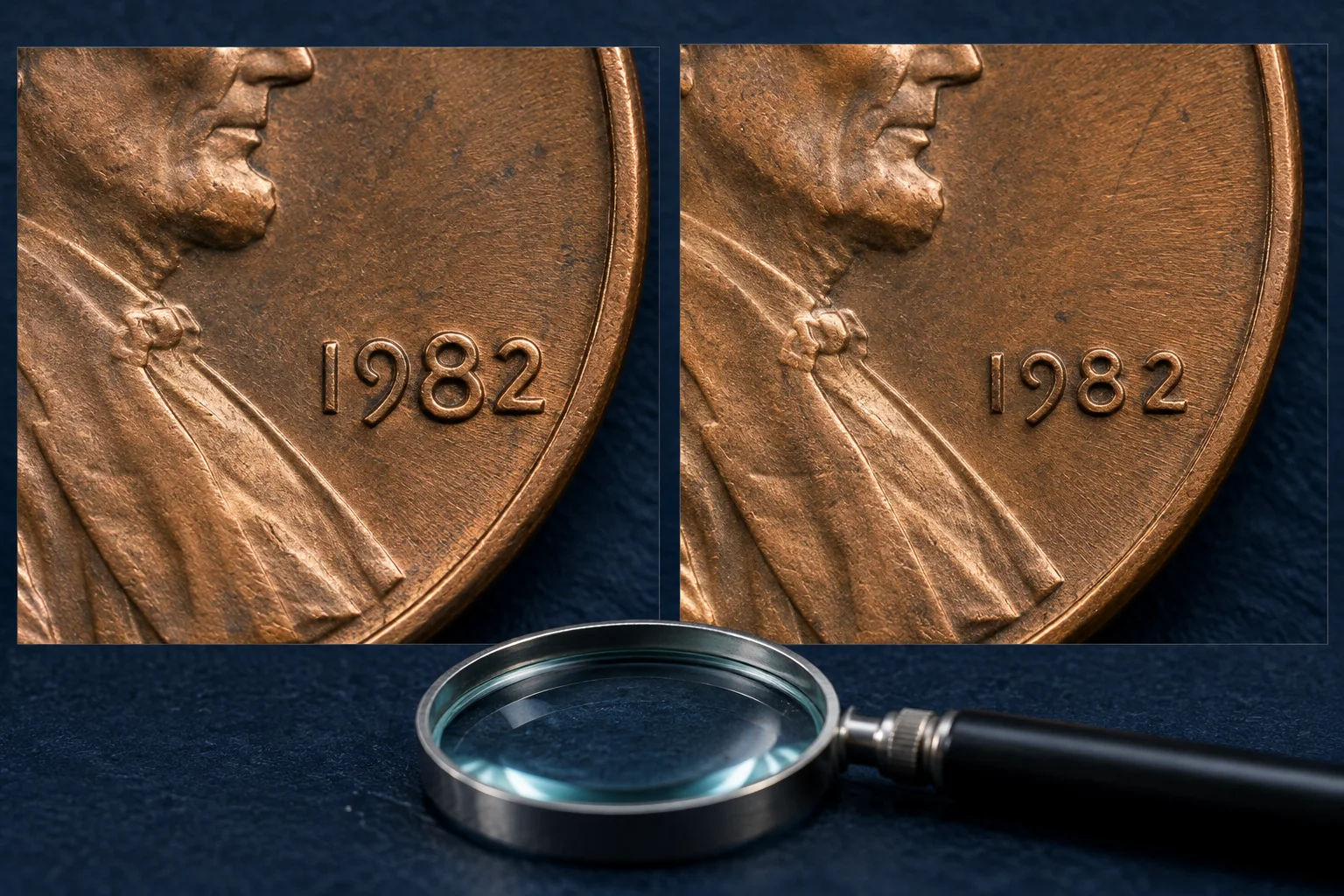
Compare design alignment, not just apparent size.
On the Large Date, the middle numerals rise higher and the lower stroke of the 2 is more direct. On the Small Date, the tops of the numerals align more closely and the lower part of the 2 has a noticeable curve. Lighting, wear and a small photograph can distort the comparison, so use a side-by-side reference and inspect the complete date.
| Feature | Large Date | Small Date |
|---|---|---|
| Numeral alignment | Middle numerals sit higher | Numerals align more closely |
| Shape of 2 | More direct descender | Curved lower descender |
| Use with weight | Still needs composition check | Never assume rare from date alone |
How to Identify a 1982 Small Date Penny
Start with the full date. Check the relative height of the digits, their spacing and the shape of the 2. Do not label a coin Small Date because the numerals merely look small in a low-resolution photograph.
A confirmed Small Date still needs a mint-mark and weight check. A no-mint-mark Small Date can be a regular Philadelphia copper or zinc cent. A D Small Date at about 2.50 grams is the regular Denver zinc variety. Only a D Small Date in the copper-alloy weight class becomes a serious transitional-error candidate.
1982 Penny With No Mint Mark
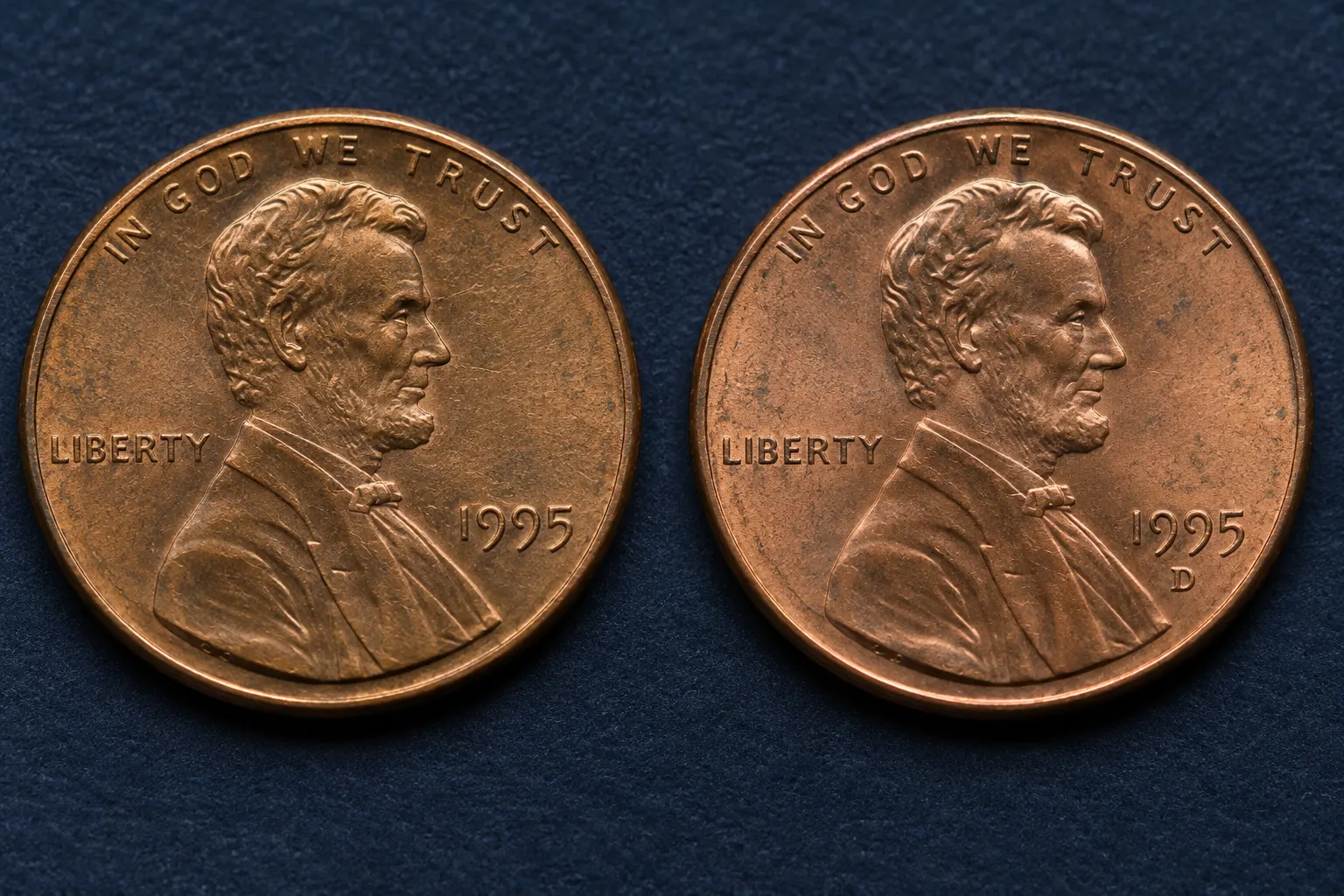
No mint mark is normal.
A 1982 cent with no mint mark is associated with Philadelphia production and is not automatically a missing-mint-mark error. Four main Philadelphia combinations are collected: copper Large Date, copper Small Date, zinc Large Date and zinc Small Date.
| No mint mark type | Weight | Date | Value direction |
|---|---|---|---|
| 1982 Copper Large Date | ~3.11 g | Large | Usually common; high grade can matter |
| 1982 Copper Small Date | ~3.11 g | Small | Premium mainly in strong certified grades |
| 1982 Zinc Large Date | ~2.50 g | Large | Usually common |
| 1982 Zinc Small Date | ~2.50 g | Small | Usually common; varieties need attribution |
1982-D Penny Value
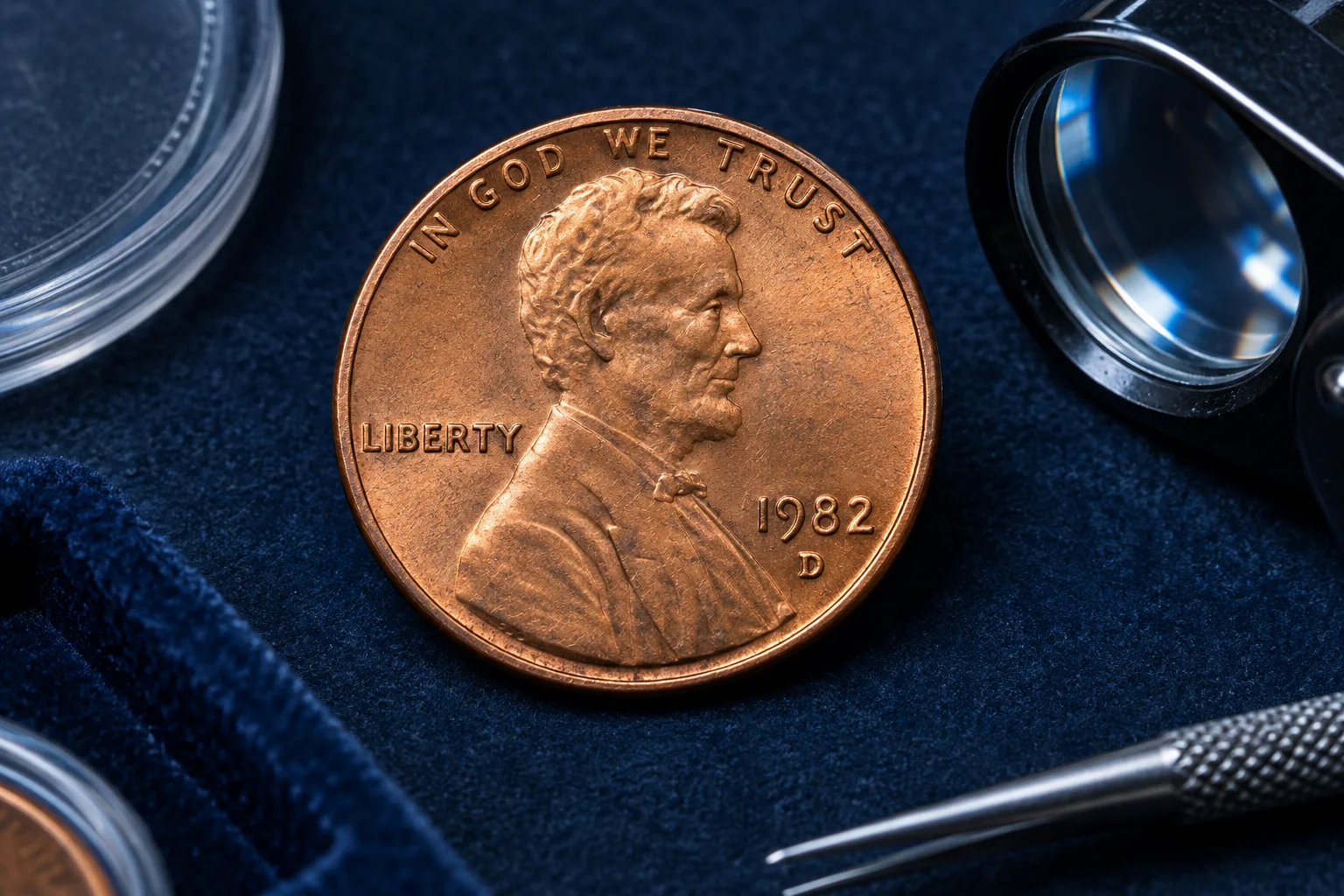
Three normal Denver combinations plus a rare error candidate.
The D mint mark identifies Denver. Normal 1982-D circulation cents include copper Large Date, zinc Large Date and zinc Small Date. The zinc Small Date is a real regular variety and normally weighs about 2.50 grams.
| 1982-D type | Weight | Date | Value direction |
|---|---|---|---|
| 1982-D Copper Large Date | ~3.11 g | Large | Regular issue; grade matters |
| 1982-D Zinc Large Date | ~2.50 g | Large | Usually common |
| 1982-D Zinc Small Date | ~2.50 g | Small | Regular variety, not automatically rare |
1982-D Small Date Copper Penny
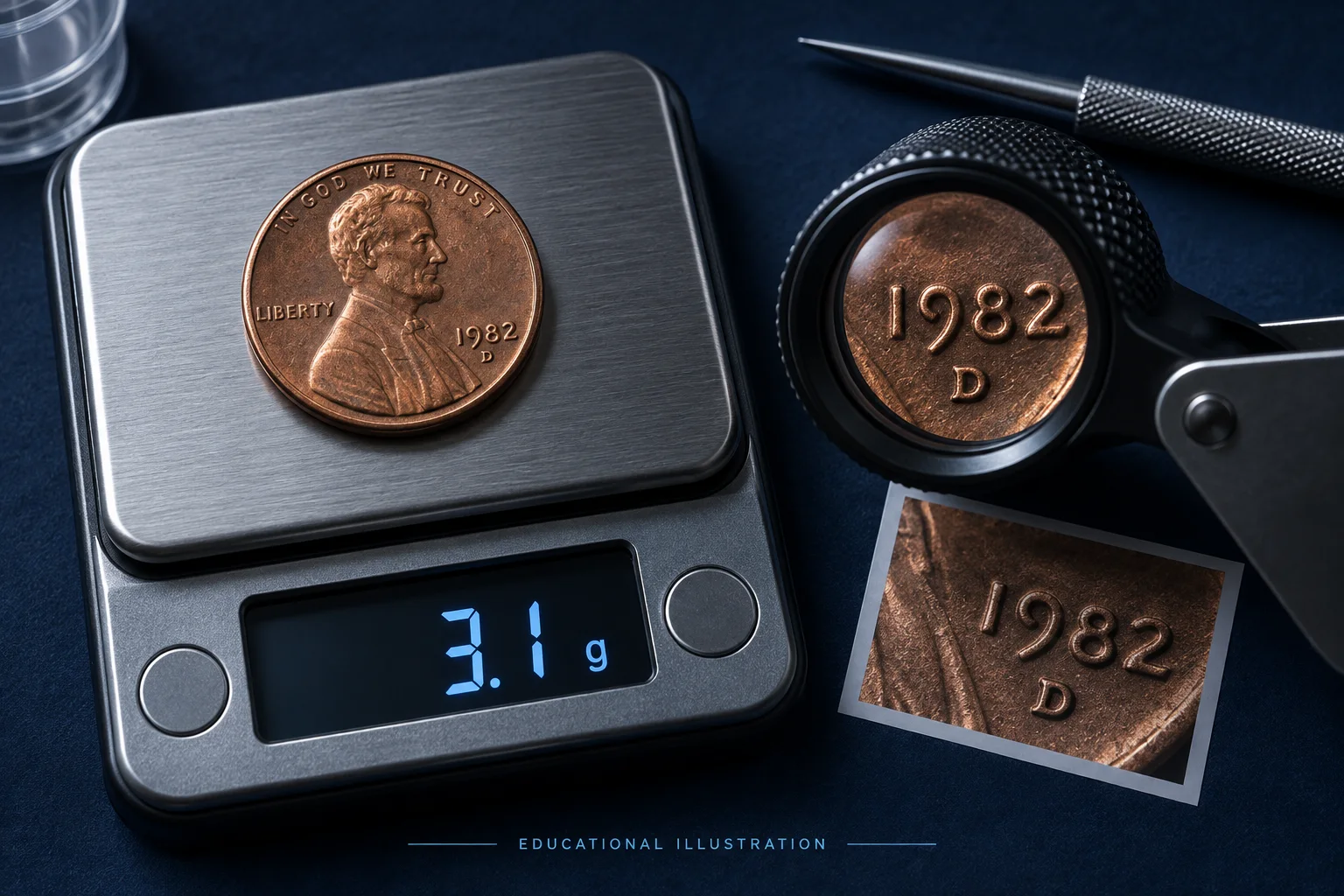
Check the combination, then authenticate.
The rare example is not simply a copper-colored Small Date. It must have the D mint mark, the Small Date design and a copper-alloy or bronze planchet weight near 3.1 grams. NGC reported a discovery specimen at 3.08 grams, graded AU 58 BN, and described it as a mint error struck from a leftover planchet.
Do not claim the coin is rare from a photograph alone. Recheck the weight, inspect the date style and keep the surface untouched. A professional attribution and grading service is appropriate before using a large value claim.
| Feature | Regular 1982-D Small Date | Rare copper example |
|---|---|---|
| Mint mark | D | D |
| Date | Small | Small |
| Weight | About 2.50 g | About 3.1 g |
| Composition | Copper-plated zinc | Copper-alloy / bronze planchet |
| Status | Regular variety | Transitional mint error |
Confirm D
- Mint mark is below the date.
- No mint mark is a different Philadelphia combination.
Confirm Small Date
- Compare the full date.
- Check the 2 and digit alignment.
Recheck weight
- Use a precise scale.
- Do not clean or alter the coin.
What Type of 1982 Penny Do I Have?
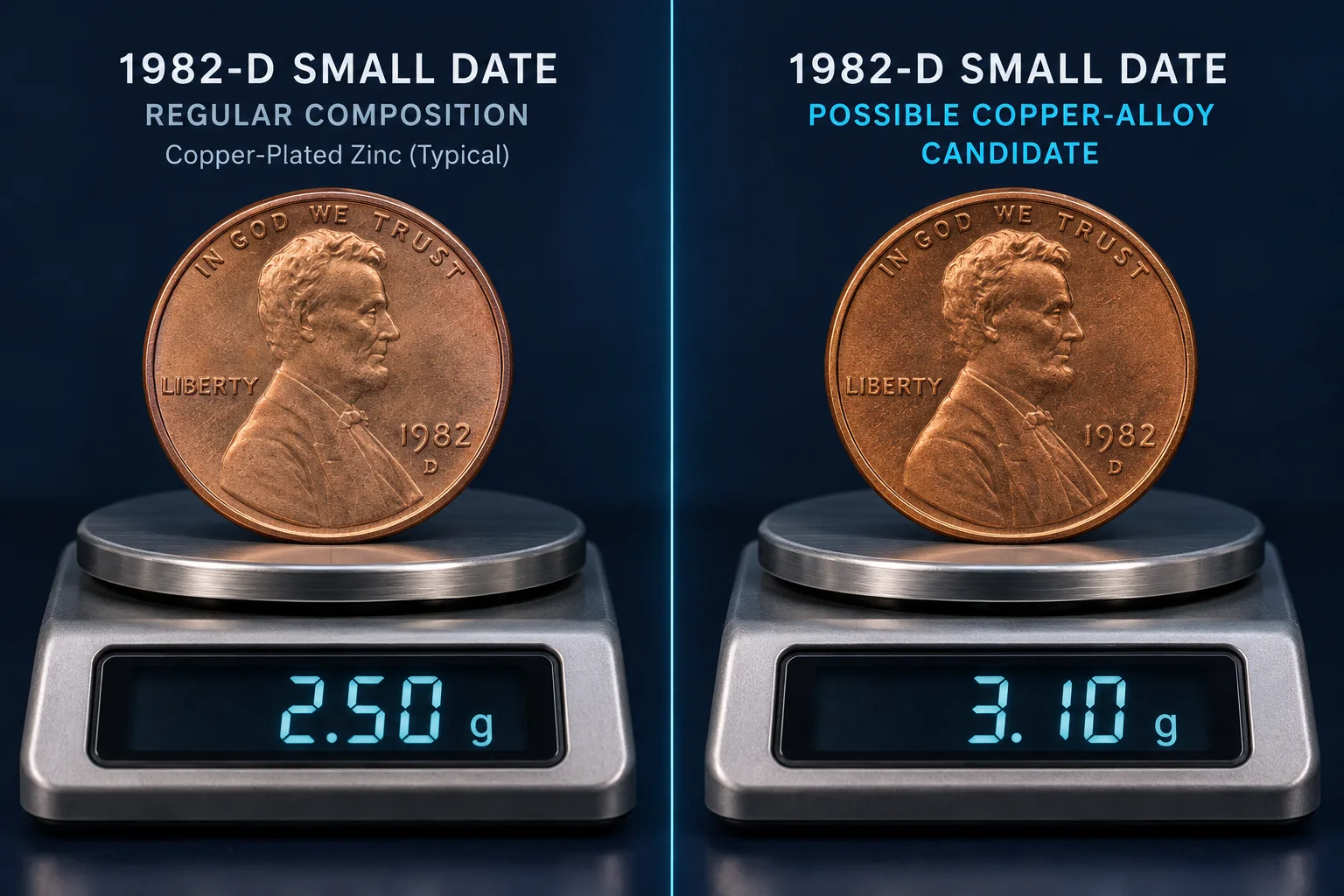
Record all three observations.
| Mint mark | Weight | Date | Likely type |
|---|---|---|---|
| None | ~3.11 g | Large | 1982 Copper Large Date |
| None | ~3.11 g | Small | 1982 Copper Small Date |
| None | ~2.50 g | Large | 1982 Zinc Large Date |
| None | ~2.50 g | Small | 1982 Zinc Small Date |
| D | ~3.11 g | Large | 1982-D Copper Large Date |
| D | ~2.50 g | Large | 1982-D Zinc Large Date |
| D | ~2.50 g | Small | 1982-D Zinc Small Date |
| D | ~3.1 g | Small | Possible rare transitional error |
Is a 1982 Penny Worth $35,000?
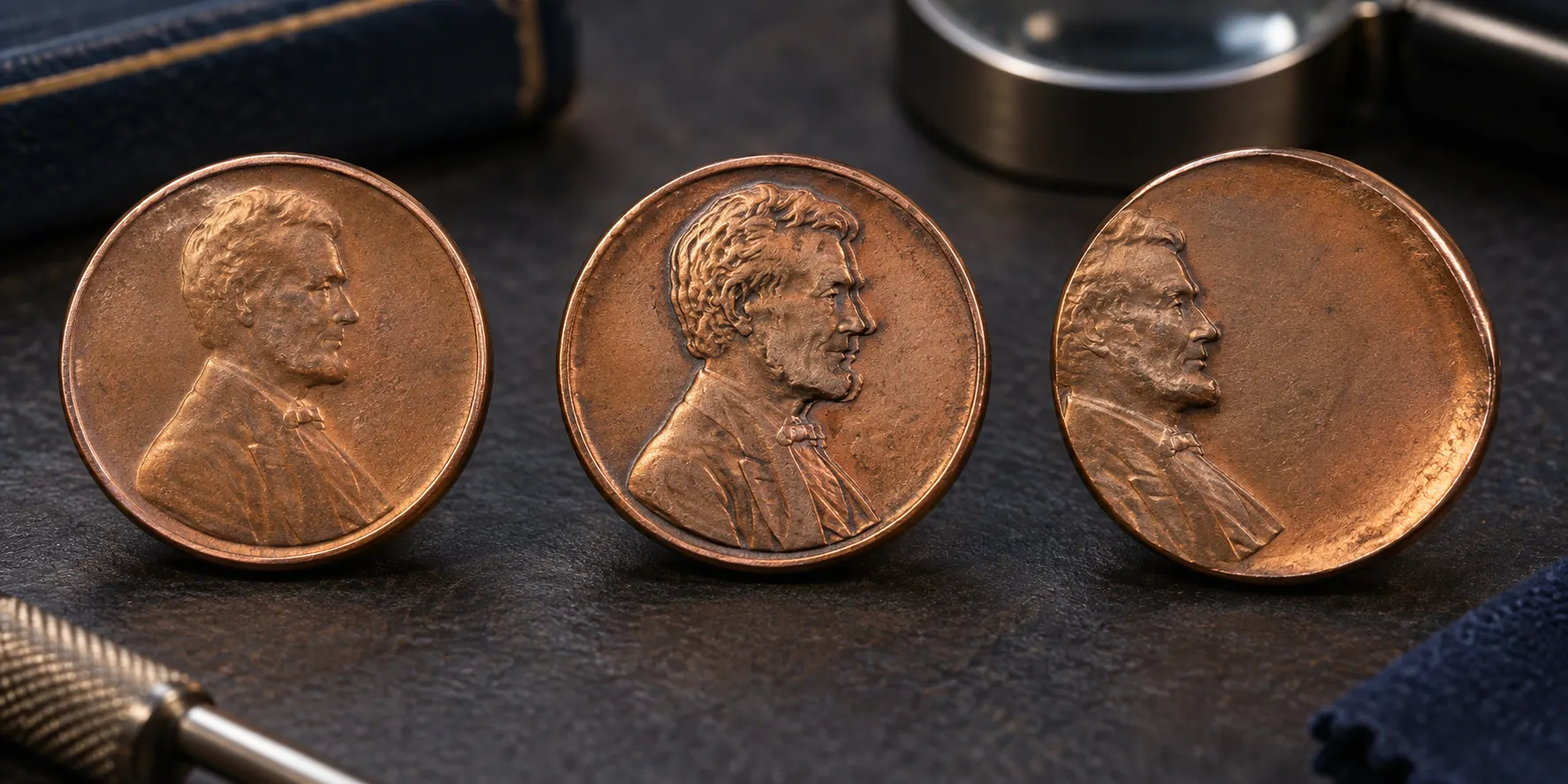
Do not apply a headline to every coin.
An ordinary 1982 penny is not worth $35,000. The number can come from a rare transitional error, an exceptional certified grade, a historic auction result, a viral article or a seller’s asking price. Those are different kinds of evidence.
A 1982-D Small Date copper error has brought substantial prices in documented sales, but the result belongs to that authenticated specimen, grade and sale date. It does not establish a fixed price for every 1982-D Small Date, and it does not make a 2.50 gram zinc cent valuable.
Which 1982 Pennies Are Valuable?
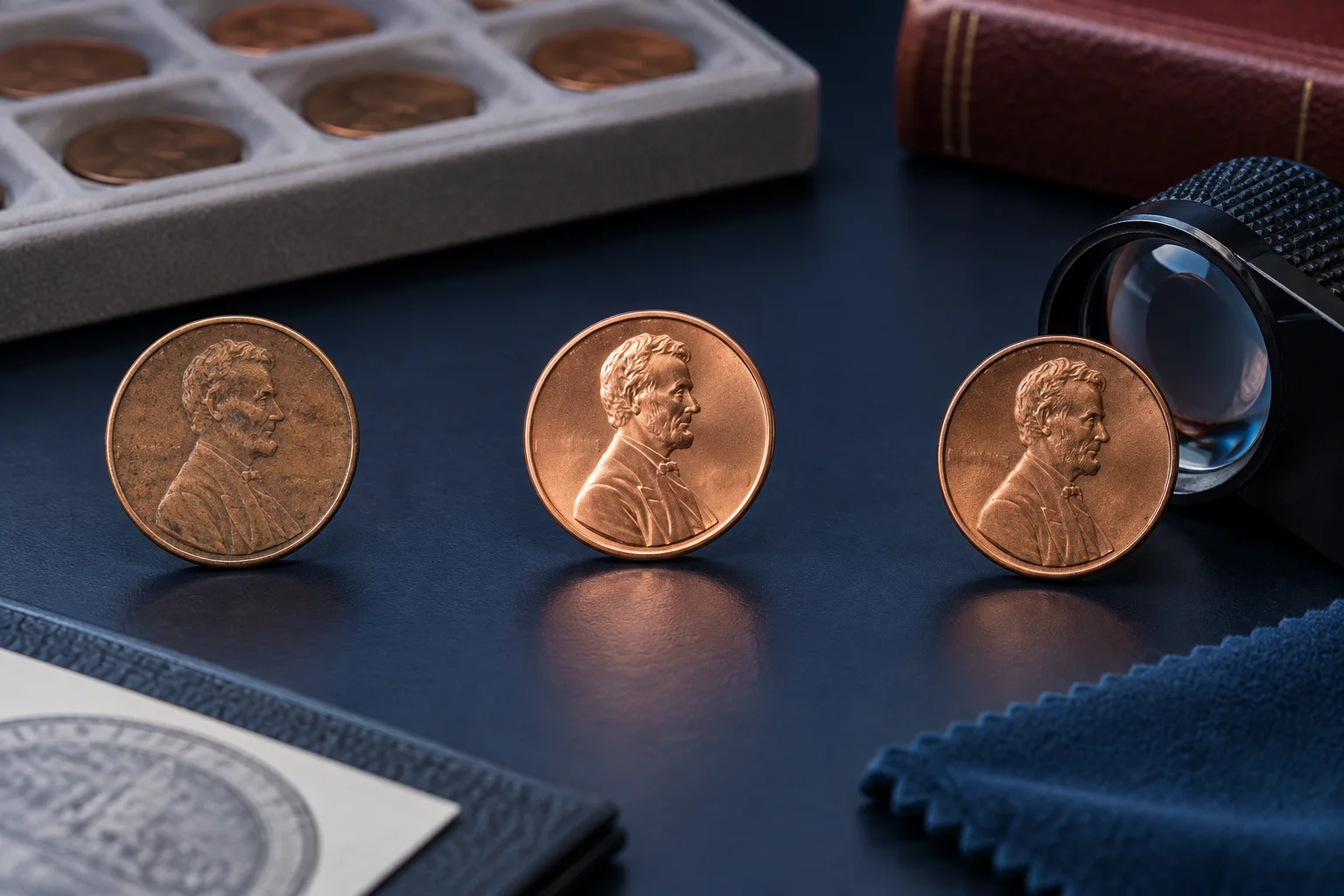
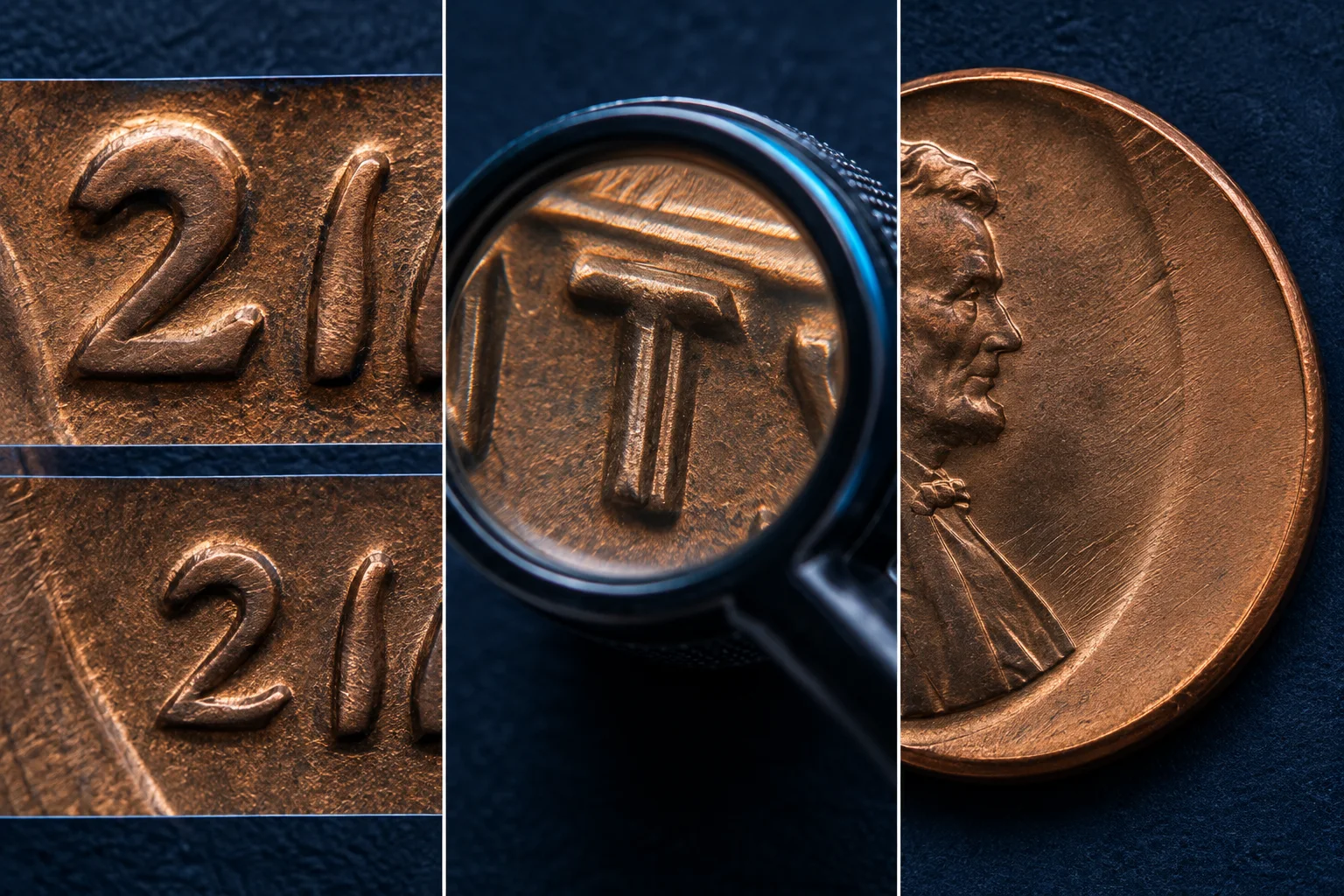
Category first, price second.
Transitional error
- 1982-D Small Date on a copper-alloy planchet.
- Weight, date and mint must agree.
- Professional authentication is essential.
High grade
- Regular copper or zinc types in exceptional certified condition.
- Color and original luster affect the market.
- Use the exact PCGS or NGC type.
Die variety
- PCGS catalogs recognized 1982 zinc Small Date DDR FS-1801 varieties.
- Doubling must match a documented attribution.
- One blurry edge is not enough.
Mint error
- Off-center, clipped, wrong-planchet and other errors need expert review.
- Do not invent an error from damage or plating loss.
- Keep the coin uncleaned.
1982 Penny Errors & Varieties
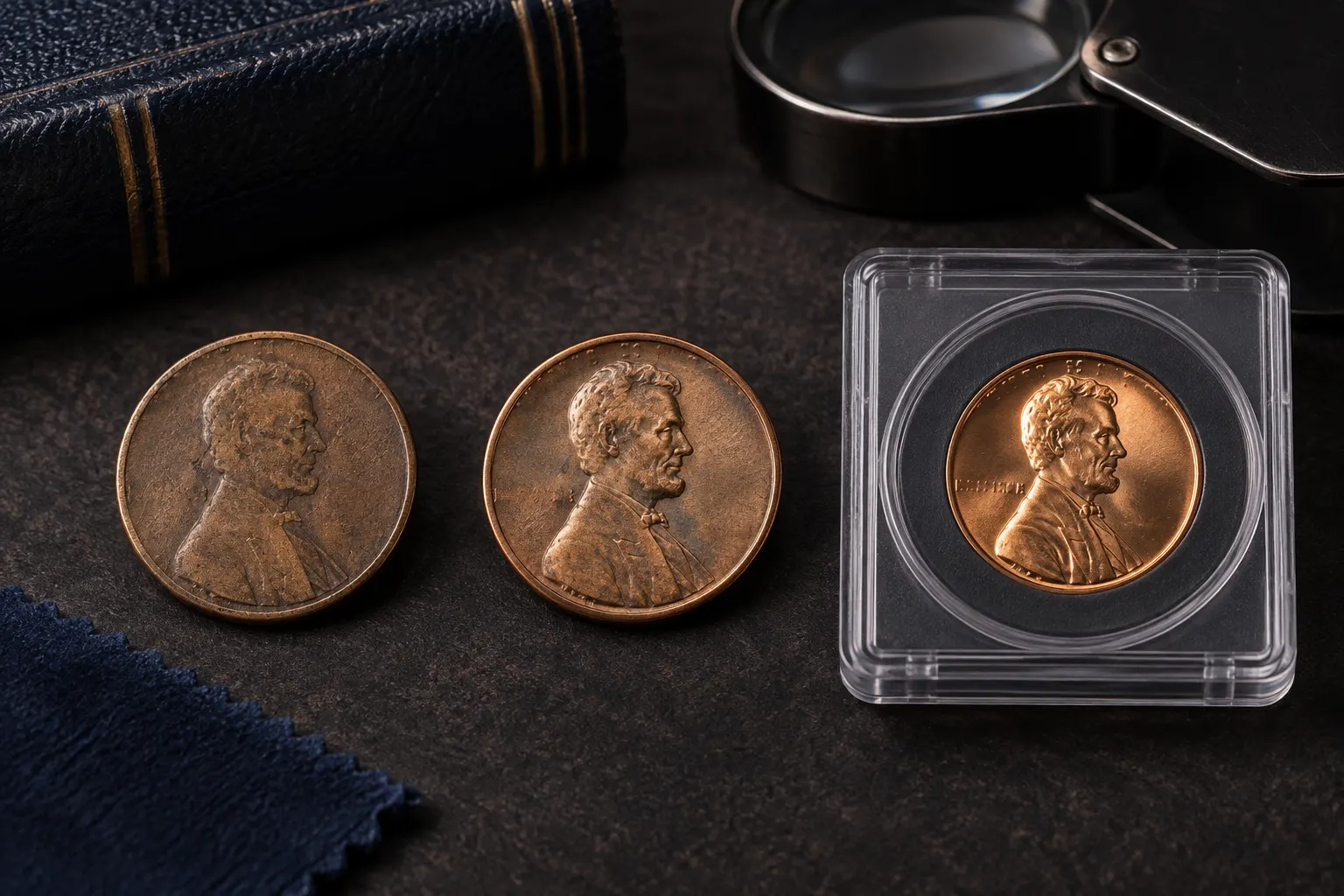
Use the right category before searching for a price.
Large Date and Small Date are design varieties. A doubled die is a die variety with repeatable design doubling. An off-center strike, clipped planchet or wrong-planchet coin is a mint error. Damage, plating loss and one blurry edge are not enough to establish a recognized error.
Are 1982 Copper Pennies Valuable?
Copper alone is not the rarity test.
Most 1982 copper-alloy cents are regular combinations. Philadelphia copper Large Date and Small Date cents are part of the normal year, and 1982-D Copper Large Date is also a normal combination. A copper-colored surface or a 3.1 gram reading must be combined with the mint mark and date size.
The standout pairing is D + Small Date + copper-alloy weight. That combination is why the scale belongs near the top of the identification process. “If it weighs 3.1 grams, you are rich” is not a safe conclusion without the other two diagnostics and authentication.
Most Valuable 1982 Pennies Sold at Auction
Representative documented results.
| Type | Grade | Certification | Auction context | Realized |
|---|---|---|---|---|
| 1982-D Small Date bronze discovery | AU58 BN | NGC Discovery Coin | Stack’s Bowers ANA, 2017 | $18,800 |
| 1982 Bronze Small Date, RD | MS67+ | PCGS | Heritage, 2014 | $9,988 |
| 1982 Zinc Small Date, RD | MS69 | PCGS | Stack’s Bowers, 2019 | $15,600 |
| 1982 Bronze Large Date, RB | MS64 RB | PCGS | Stack’s Bowers, 2024 | $1,110 |
Each result belongs to one certified coin and one market date. PCGS notes that some listed auction records are eBay transactions and warns that listing authenticity is not guaranteed; major-house results are stronger context for a large claim.
Why Are There So Many 1982 Penny Varieties?
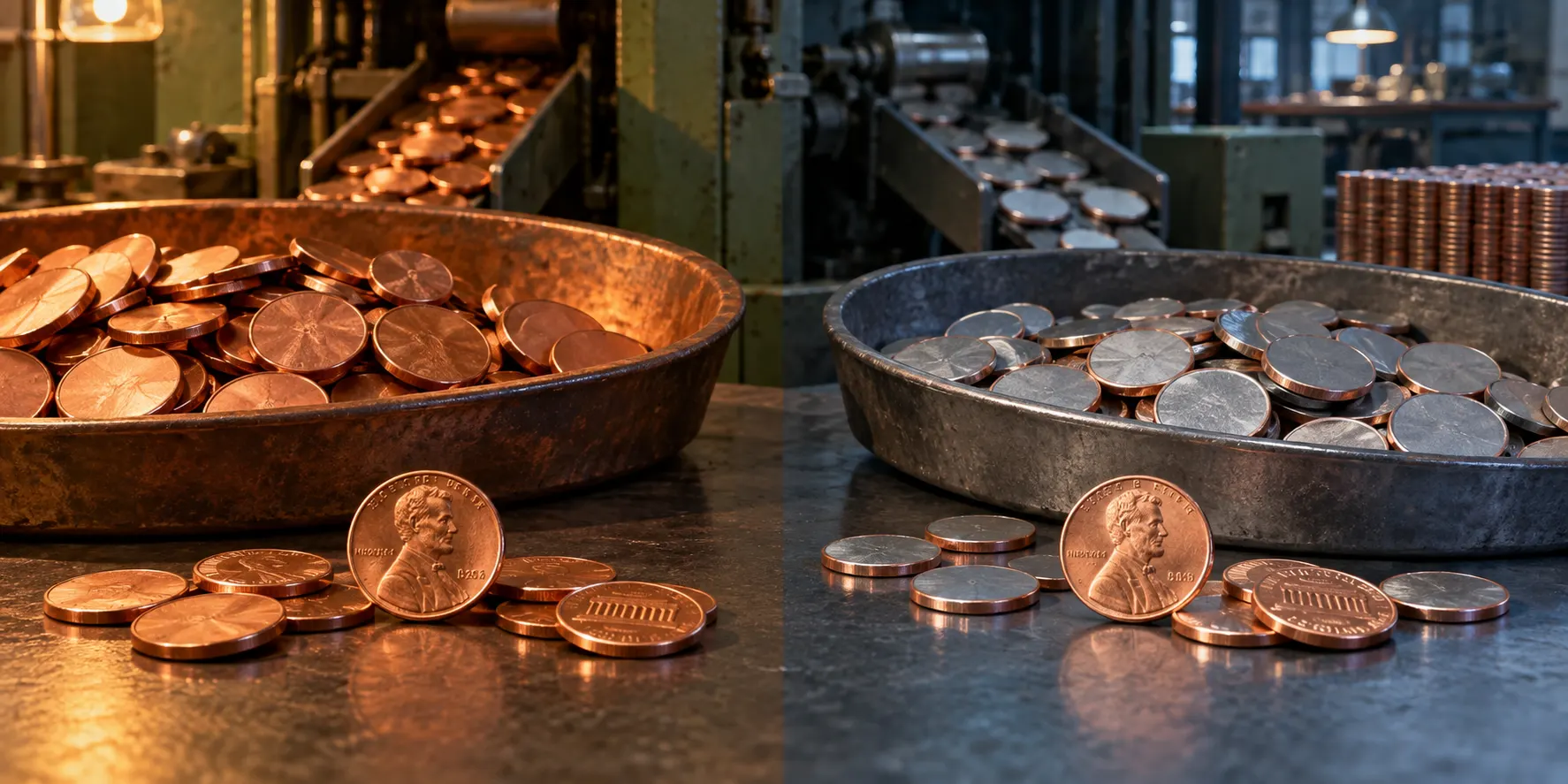
The U.S. Mint used 1982 as a transition year for the cent. Traditional copper-alloy planchets continued while the Mint introduced copper-plated zinc planchets. That change created two practical weight classes: about 3.11 grams and about 2.50 grams.
The obverse hub was also revised during the year, producing Large Date and Small Date designs. Philadelphia and Denver then combined with those composition and date changes. NGC describes seven regular circulating combinations. The later-discovered 1982-D Small Date bronze example is treated as a mint error because it was struck on a leftover planchet, not as a normal eighth production combination.
1982 Penny Specifications
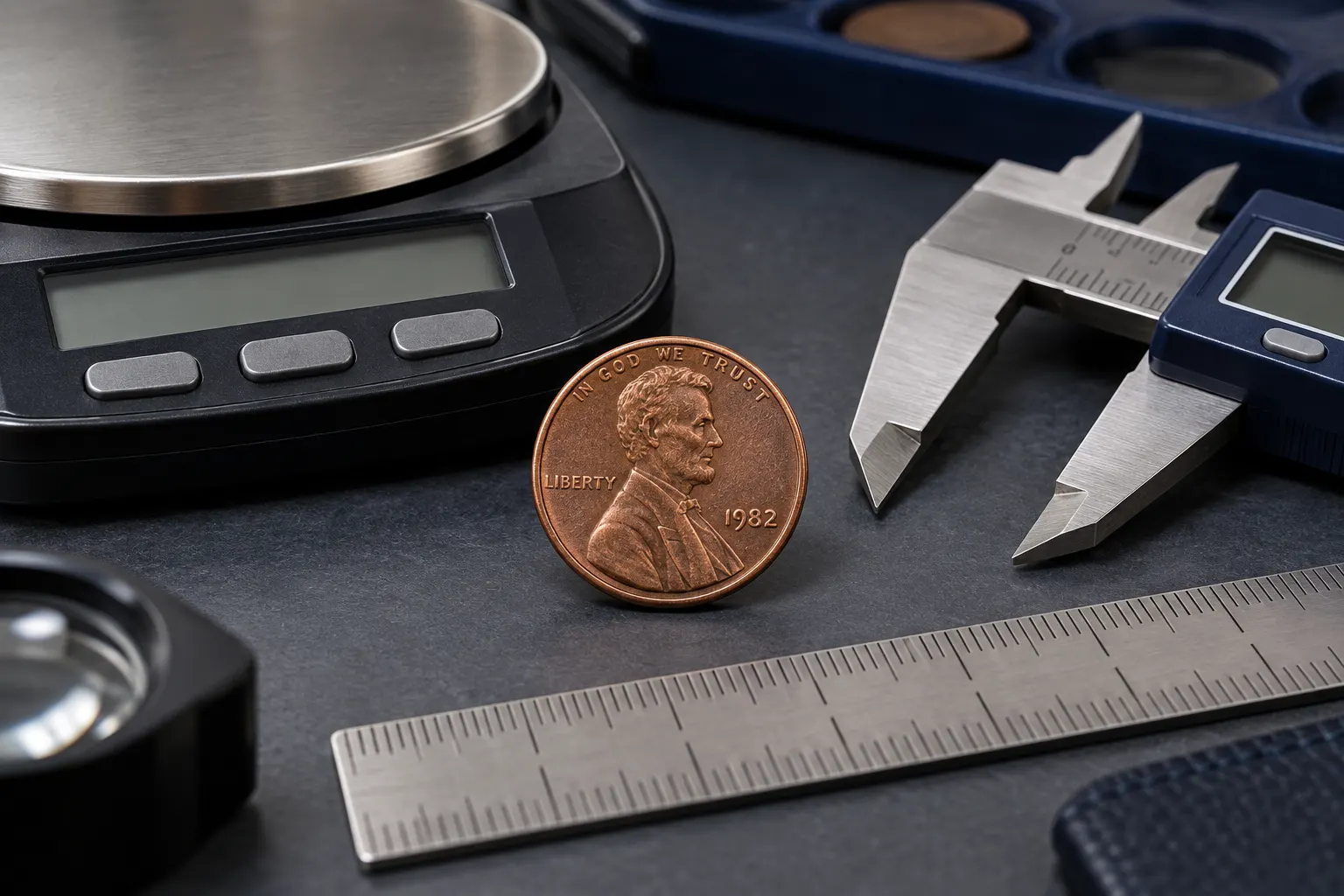
Two composition classes share the Lincoln Memorial design.
| Specification | Copper alloy | Copper-plated zinc |
|---|---|---|
| Denomination | One cent | One cent |
| Composition | 95% copper, 5% zinc alloy | Copper-plated zinc |
| Weight | About 3.11 g | About 2.50 g |
| Diameter | 19.00 mm | 19.00 mm |
| Edge | Plain | Plain |
| Obverse | Lincoln portrait | Lincoln portrait |
| Reverse | Lincoln Memorial | Lincoln Memorial |
Victor David Brenner designed the obverse and Frank Gasparro designed the Lincoln Memorial reverse. PCGS lists a 19.00 mm diameter and plain edge for both classes.
Should You Clean a 1982 Penny?
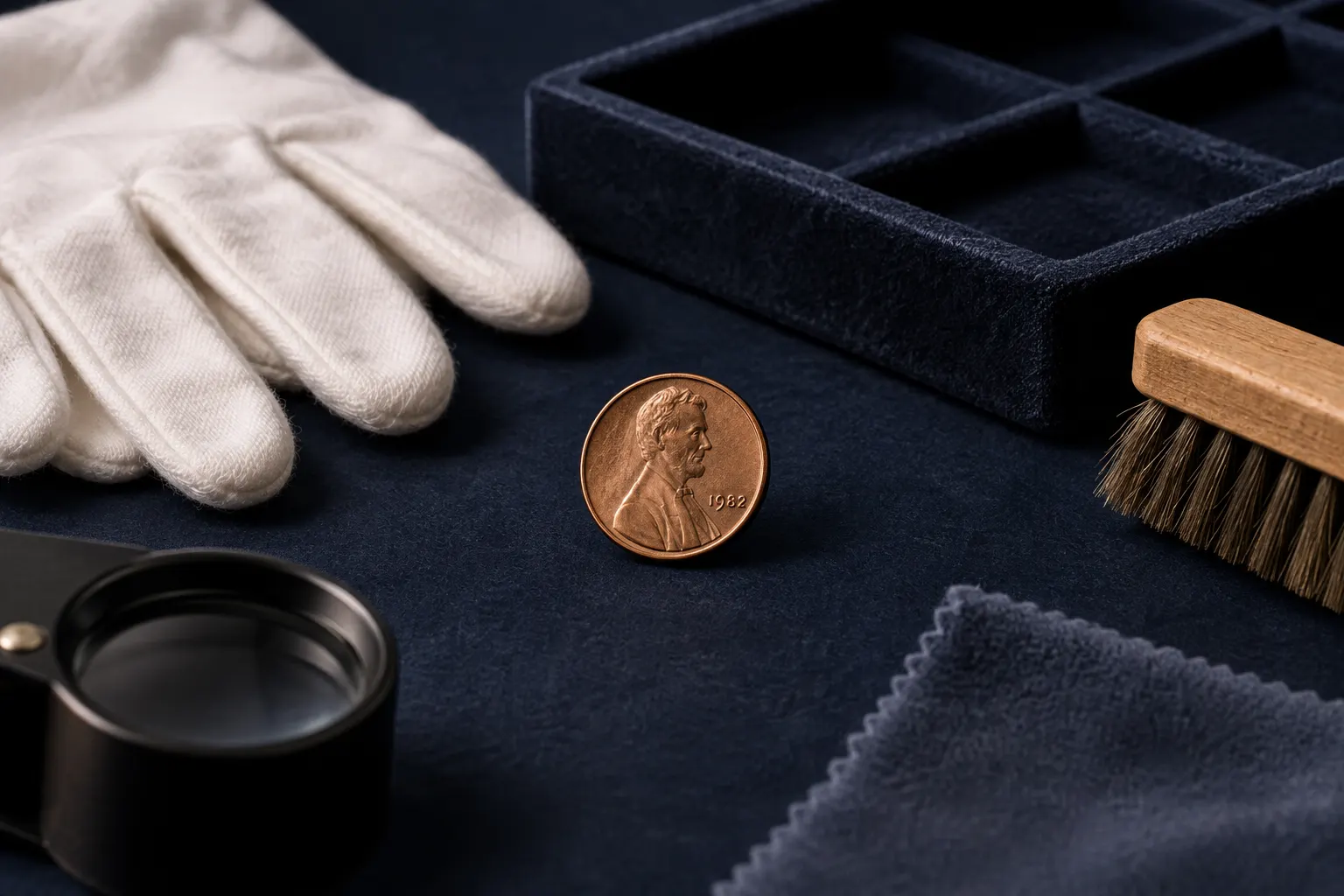
No. Cleaning can create hairlines, remove original surface and change the color designation. This matters most for a possible 1982-D Small Date copper error, where the coin should be weighed, photographed and professionally reviewed without alteration.
1982 Penny FAQ
How much is a 1982 penny worth?
Most circulated 1982 cents are common. Value depends on the exact mint mark, composition, date size, condition, surface and any recognized variety or mint error.
Which 1982 penny is valuable?
The rarest headline variety is the 1982-D Small Date struck on a copper-alloy planchet. High-grade regular varieties and recognized die varieties can also bring premiums, but most 1982 cents are not rare.
How can I tell if my 1982 penny is copper or zinc?
Weigh it on a precise digital scale. A copper-alloy 1982 cent is about 3.11 grams; a copper-plated zinc cent is about 2.50 grams. Color alone is not reliable.
What is the difference between a 1982 Large Date and Small Date?
Compare the height and alignment of the numerals and the shape of the 2. On the Small Date, the numerals align more closely and the 2 has a curved lower descender; use a recognized comparison image rather than a quick visual guess.
What is a 1982 penny with no mint mark?
It is a normal Philadelphia-type issue. No mint mark does not mean the coin has a missing-mint-mark error.
How much is a 1982-D penny worth?
Most 1982-D cents are common in circulated grades. Separate the regular Large Date copper, Large Date zinc and Small Date zinc combinations from the rare copper Small Date error before comparing prices.
Is every 1982-D Small Date penny rare?
No. The regular 1982-D Small Date is a copper-plated zinc cent and weighs about 2.50 grams. A copper-alloy weight is the warning sign that calls for professional review.
What is the rare 1982-D Small Date copper penny?
It is a transitional mint error: a Denver Small Date struck on an older copper-alloy or bronze planchet. NGC certified a discovery specimen weighing 3.08 grams and graded AU 58 BN.
Is a 1982 penny worth $35,000?
An ordinary 1982 penny is not worth $35,000. Large claims usually refer to a particular authenticated error, exceptional grade, old auction result or an asking price. Confirm the exact coin and completed sale before using any number.
Related Lincoln Cents
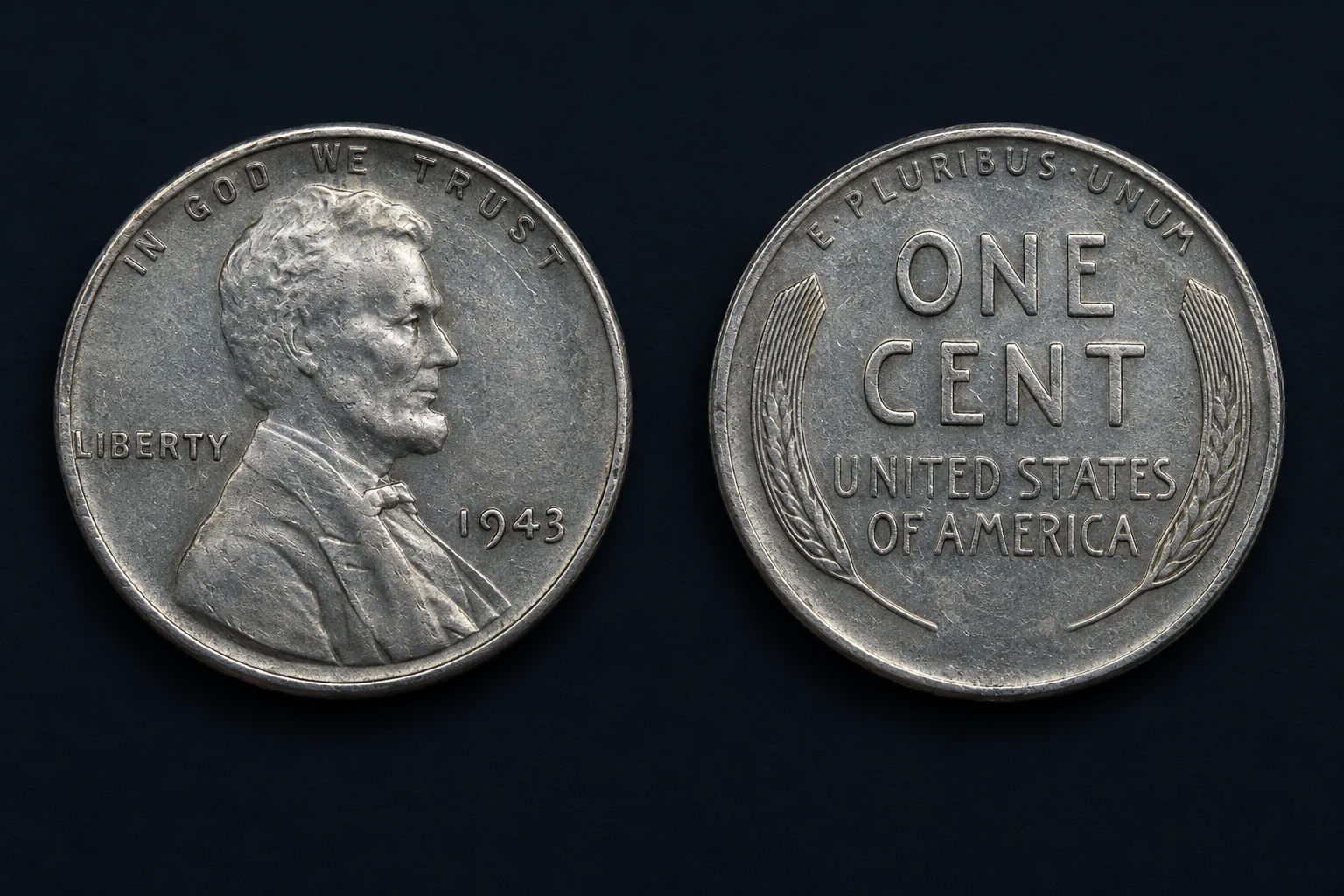
1943 Steel Penny
Compare composition, diagnostics and market context.
View coin →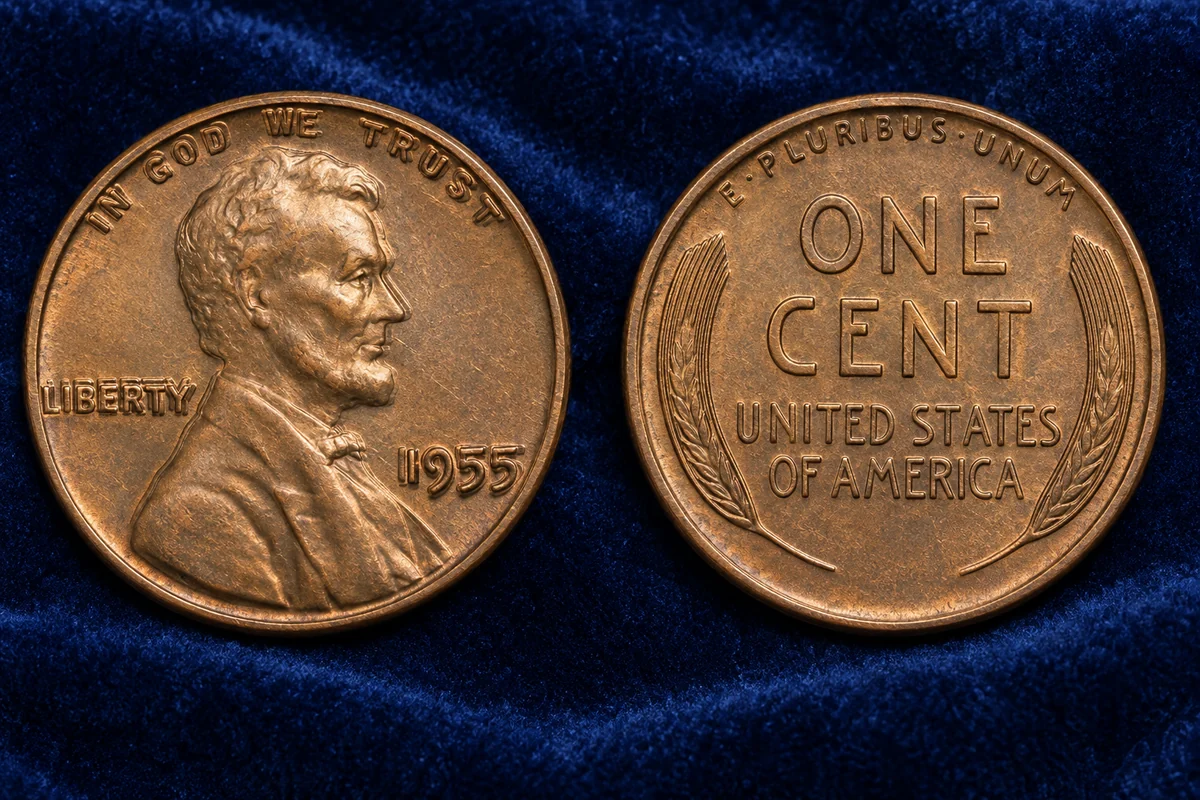
1955 Doubled Die Penny
Compare composition, diagnostics and market context.
View coin →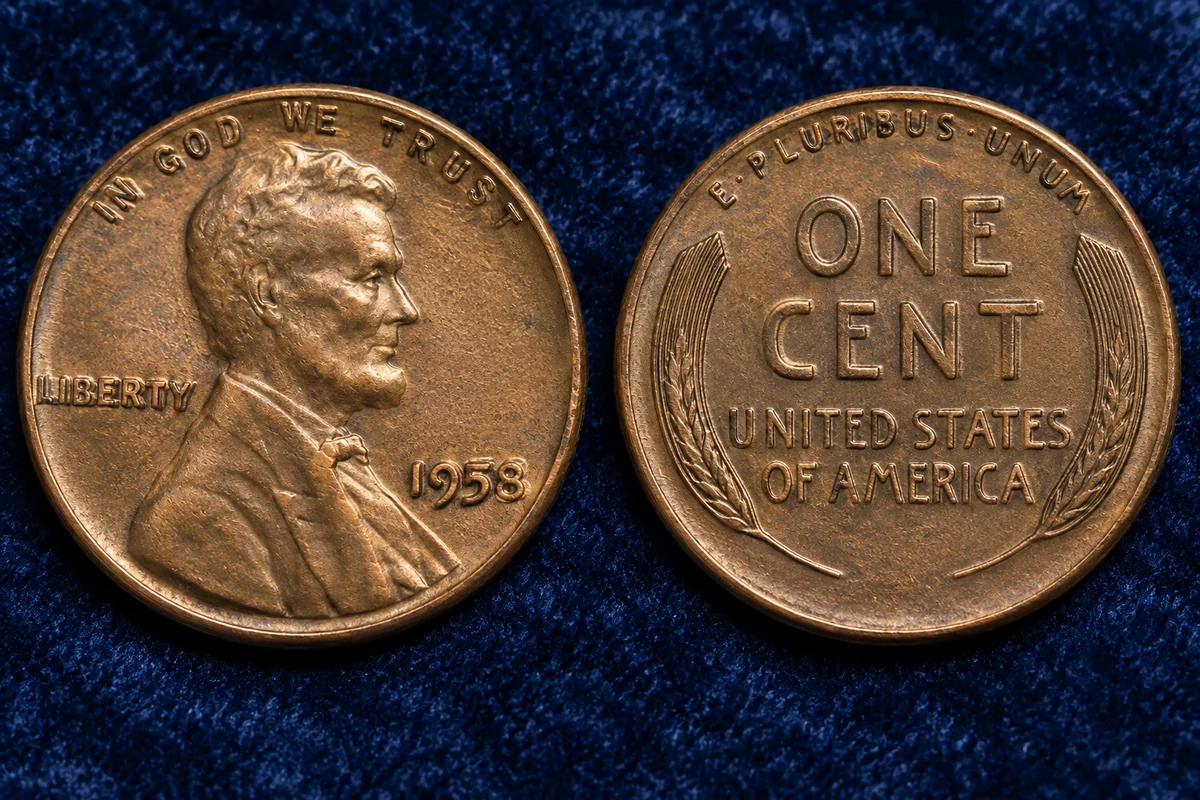
1958 Doubled Die Penny
Compare composition, diagnostics and market context.
View coin →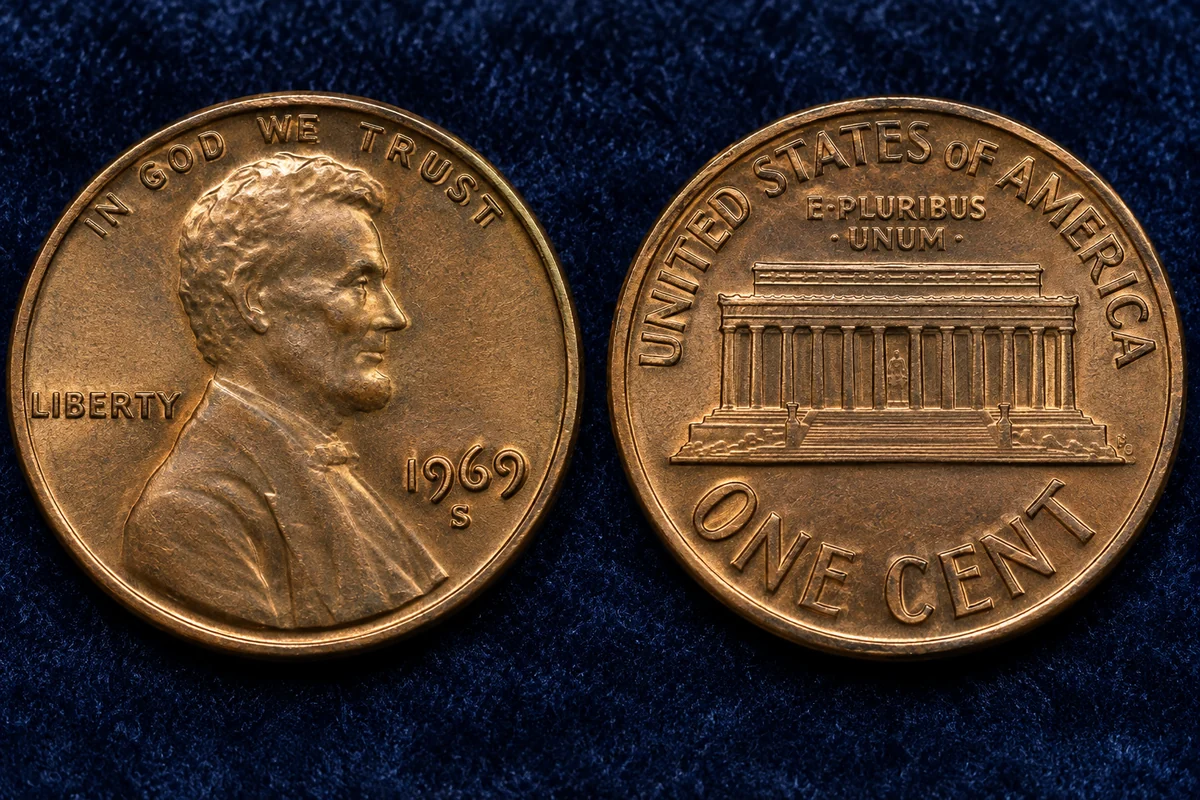
1969-S Doubled Die Penny
Compare composition, diagnostics and market context.
View coin →